


NIKKI MEREDITH TALK
- lorenzo butturini

- Oct 28, 2020
- 3 min read
Updated: Jan 6, 2021
This week (week 5), I attended a lecture (on Youtube) led by Nikki Meredith revolving around her job as a Supervisor for the Royal Exchange in Manchester and the process of working on a play. Throughout her career, Nikki mostly worked in Theatre (but occasionally she worked in the Film industry as well). For the past years, she has been working at The Royal Exchange. However, due to the current Pandemic, all productions have stopped.
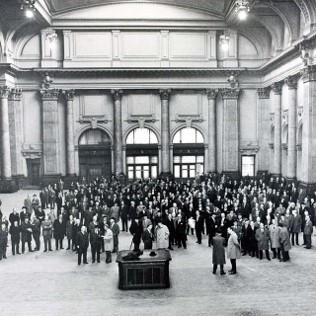
The whole talked mostly revolved around Costume design examples of Designers who worked for various Productions at the venue. However, she raised valuable points about designing the Set and Scenery in the famous Theatre. For instance, she started off giving a brief explanation of the history of the Exchange and its structure. It was fascinating finding out that the venue was initially a Cotton Trading Hall, which got converted into theatre-space after being bombarded during WWII. Below, a picture of the Cotton Trading Hall (on the left) and a picture of the Royal Exchange as it is now (on the right).



THE THEATRE
The design (originally by Richard Negri) involves a 360-degree space in which the audience surrounds the stage in its entirety. The stage is small, and the seating is quite limited (providing a feeling of intimacy between the audience and the actors). Also, the ceiling can move according to the lighting needed for the play.
The layout itself is extremely peculiar, and as Nikki said, it reminds of a Circus ring. Its unusual structure makes designers work more challenging and fun, from designing sets to designing costumes. In a 360-degree theatre, there is no backstage nor anywhere to hide. That is why every change of costume needs to happen outside the Theatre. I found this aspect extremely curious! I never heard of anything like it before.
INTERESTING FACTS ABOUT WORKING IN THEATRE
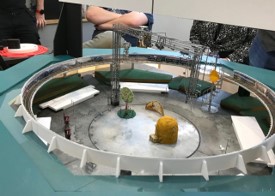
Nikki stressed out the importance of well-executed models. These are still fundamental in the theatre industry (and also in television) because they can convey perfectly (on a smaller scale) the final result. During the production of a play, there are various meetings in which designers come up with basic card models and plans that eventually develop until they reach the final (and most accurate) stage as shown in the pictures below. Another interesting fact I was not aware of, is that (in theatre) most of the designers have to deal both with designing the sets and costumes.




DUTIES OF A SUPERVISOR
Being a Supervisor requires advanced multitasking and problem-solving skills. Nikki's role involves having to deal with costs (related to costumes and more), attending various meetings with designers, dealing with paperwork and, most of all, be able to please everyone (from the actors to the designers). The amount of pressure she faces daily seems unbearable.
SOME THOUGHTS
I found this lecture entertaining and insightful. Getting to know a bit better about working in the Theatre industry was very interesting. The format of this lecture reminded me of last year. In the second trimester (in level 5) we got the chance to attend various sessions with professionals regarding their jobs. Throughout these sessions, we explored in depth a wide range of jobs in the film and Theatre industry, allowing us to receive useful tips and advice for our future career. However, I have to admit that this seminar confused me a little. Most of Nikki's talk revolved around Costume design, and the examples she brought up also mostly concerned Costume designers and their styles rather than focusing on the set design aspect. Today's session allowed me to expand my knowledge of the Theatre industry and made me reflect a bit more about my future career. I am still quite unsure about the path I want to follow. Back in level 4, I felt quite confident about working in the film industry, but these certainties started to shake at the end of my second year. At that stage, I started becoming more and more interested in working in theatre. I still have not made up my mind about it, but I am not too worried because I still have got quite some time ahead.


Comments